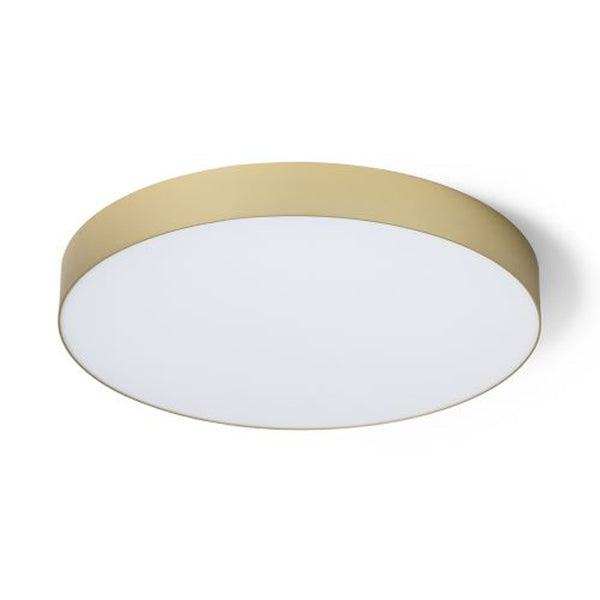
Ceiling lights for kitchens provide essential ambient lighting that enhances safety, precision, and overall visual comfort. In the kitchen, where food preparation, handling tools, and everyday movement take place, lighting must be carefully planned—considering luminous flux, light distribution, and glare control.
Properly designed kitchen ceiling lights are based on the room size, ceiling height, and layout of the work area. Each kitchen ceiling fixture should reflect the actual use of the space, not just aesthetic preferences. Different setups are needed for a compact 10 m² kitchen compared to an open 25 m² kitchen-dining area. A key factor is also the long-term stability of LED performance to ensure consistent light intensity over time.
The role of kitchen ceiling lights in the space
Kitchen ceiling lights serve as the main task lighting. Their goal is to provide even illumination without harsh shadows, especially over countertops, cooking surfaces, and traffic paths.
A typical solution is a central kitchen ceiling fixture or a system of recessed spotlights. Drywall ceilings often use LED recessed spotlights or LED ceiling panel lights, allowing precise positioning of light points over different zones. Alternatively, a prominent ceiling light combined with secondary fixtures can be used.
A common mistake is underestimating the light output—installing a single fixture with insufficient luminous flux where at least 300–500 lx is required on the work surface. Insufficient lighting causes shadows and increased eye strain.
Technical specifications for kitchen ceiling lighting
Luminous flux (lumens) defines the amount of emitted light. For a 15 m² kitchen, we recommend a total luminous flux of about 4,500–6,000 lm, which corresponds to an average illuminance of around 300 lx. Higher levels are suitable for heavily used kitchens or those lacking natural light.
Color temperature usually ranges between 3,000 K and 4,000 K. Neutral white (around 4,000 K) supports concentration and accurate color perception of food. A recommended CRI ≥ 90 ensures true color rendering, important for checking the freshness of ingredients.
Beam angle affects light uniformity. A wider distribution (90–120°) suits central kitchen LED ceiling lights, while narrower angles in spotlights allow focused illumination of specific work areas. Every quality kitchen ceiling light should have optics matched to the ceiling height and desired evenness. Poor combinations can cause sharp contrasts between the countertop and surroundings.
Glare control is crucial especially with glossy kitchen surfaces. Fixtures with deep optics, quality diffusers, or microprismatic covers reduce uncomfortable glare when looking upward.
LED thermal management directly impacts long-term performance stability. Each kitchen ceiling fixture should have adequate cooling to minimize brightness drop over years of use.
Dimmability allows adjusting light levels to the time of day—full brightness for cooking, lowered intensity in the evening. If the kitchen ceiling light is dimmable, compatibility between the driver and dimmer should be verified during the design phase.
In areas with increased moisture or near cooking zones, appropriate IP rating should be considered, such as IP44.
Practical lighting design scenario
For a 20 m² kitchen with a 2.6 m ceiling, a layout might include 6 recessed fixtures with 800–1,000 lm each. Spacing of 1.2–1.5 m ensures even light spread without dark spots. This setup creates a reliable base layer for kitchen lighting.
A frequent mistake is placing fixtures only around the room perimeter, resulting in poor illumination in the center and shadows at the work surface.
We recommend dividing kitchen ceiling lights into at least two separate circuits during electrical installation—main lighting and supplementary lighting. This increases flexibility and future control options.
Design and proportions in architectural context
Kitchen ceiling lights can either stand out as visual features or blend seamlessly into the ceiling plane. Minimalist interiors often use recessed kitchen LED ceiling fixtures that preserve clean lines.
Materials like aluminum or painted metal support effective cooling while respecting the technical character of the space. Adjustable fixtures allow directing light precisely over an island or workspace without structural changes.
Design here serves to complement architecture—the fixture’s shape should enhance function, not replace it.
Control, maintenance, and long-term value
Dimming options increase space versatility throughout the day. Kitchen ceiling lighting should enable smooth brightness adjustment without flicker or color shifts.
Multiple lighting circuits allow separating task and ambient modes. Serviceability—such as access to power supplies without dismantling the entire fixture—reduces future operating costs.
Well-designed kitchen ceiling lights maintain stable output even after thousands of hours in use. When planned during electrical installation, this creates a system that supports the space’s functionality long term without major modifications.